





Researchers Uncover Genetic Insights Into Human Diseases Through ORIP’s National Primate Research Centers
Nonhuman primates (NHPs) offer valuable insights into many diseases that affect human health because they are genetically and physiologically very similar to humans (Figure 1). ORIP’s National Primate Research Centers (NPRC) Consortium maintains NHP colonies for use by the biomedical research community. Dr.
Fruit Fly Fourth Chromosome Resource Project Creates New Resources for Biomedical Research
Drosophila melanogaster, commonly known as the fruit fly, is a model organism utilized in biomedical research to understand the conserved molecular mechanisms underlying health and disease. D. melanogaster offers many advantages in the laboratory, including short generation time and the ability to conduct sophisticated genetic experiments inexpensively. “Changing gene expression experimentally at the level of single cells or individual tissues is straightforward for fly geneticists, and the stocks don’t cost much once they’re developed.
Micron-Scale Bioglass Confirmed with S10-Supported Optical Tweezers for Biomedical Research
Biologically based glass (i.e., bioglass) has a longstanding history in health applications. Synthetic bioglass was developed in the late 1960s and has since been used in many ways. This silica-based, biodegradable material is less likely to be rejected by the body than many other materials used for medical implants.
A Fly Model to Mimic a Rare Chronic Genetic Disease in Patients
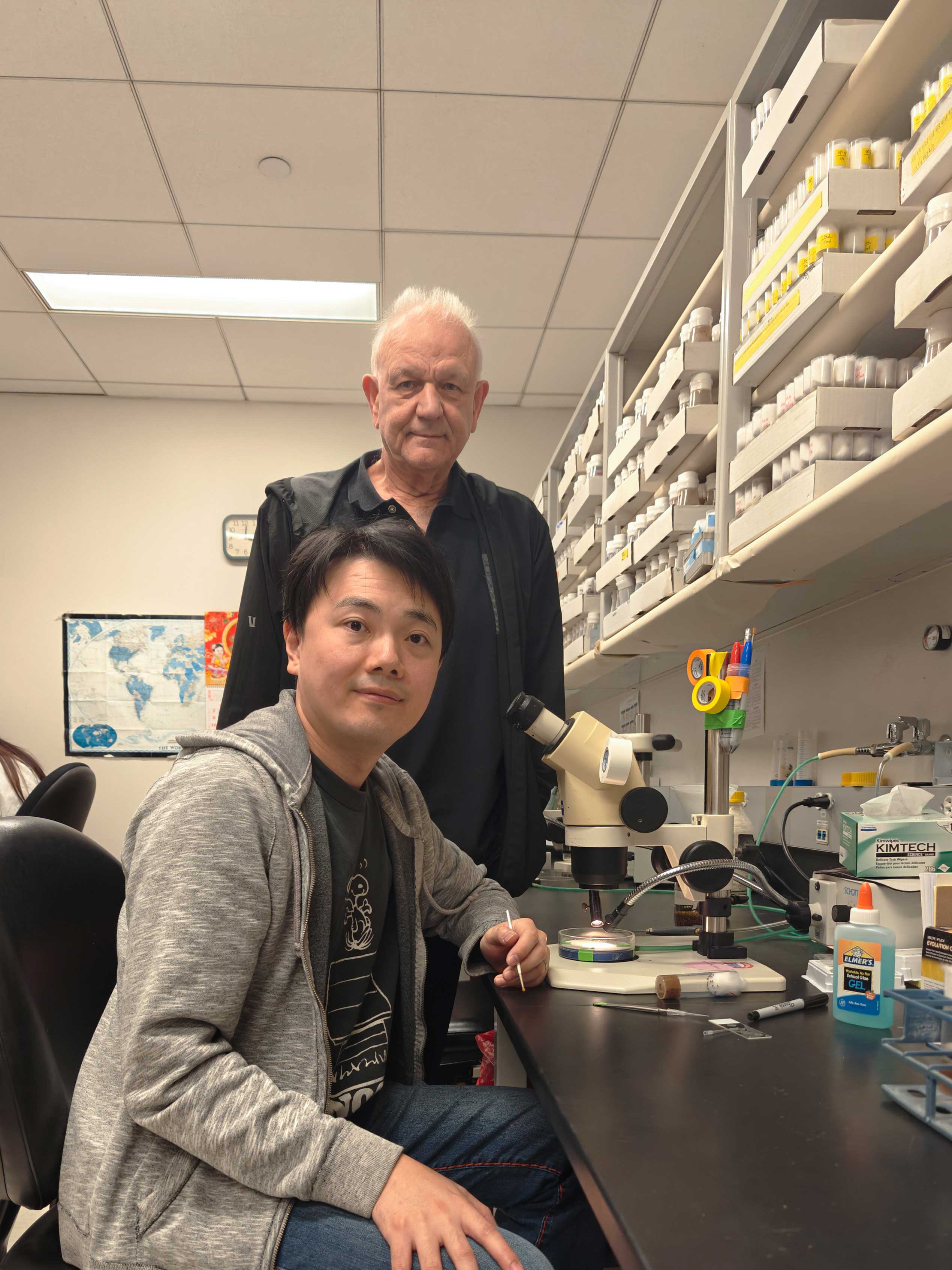
Figure 1. Drs. Xueyang Pan and Hugo Bellen in front of a dissection scope in the fly room. Image courtesy of Dr. Xueyang Pan, Baylor College of Medicine.
ORIP Strategic Plan 2021–2025 Archive
.listitem {
margin: 15px 0;
}
hr {
margin-top: 1rem;
margin-bottom: 1rem;
border: 0;
border-top: 1px solid #807F83;
}
Progress on Theme 1: Animal Models to Advance the Study of Human Disease
Accordion Section
Seeing the Invisible: Detecting Early Lung Diseases with Advanced Computed Tomographic Imaging
For decades, physicians have relied on spirometry to detect chronic obstructive pulmonary disease (COPD). However, the global metrics derived from spirometry (a noninvasive breathing test) cannot sense regional lung damage in early disease. By the time these global indices of lung disease signal a decline, years of subtle damage to the lungs already have taken place. Dr. Eric A.
S10 Grant Applications: Frequently Asked Questions

Accordion Section
Questions Relevant to All S10 Programs
General Questions
General Instruments and Their Administration
General Advisory Committee Requirements
General Submission and Resubmission (A1) of an S10 Application
Other General Submission Guidelines
Questions for the Shared Instrumentation Grant (SIG) Programs
SIG Instruments and Their Administration
SIG PI, Major User Group, and NIH User Group Requirement
SIG AUT Requirement
SIG: Other Submission Guidelines
Questions for the SIS Program
SIS General Questions
SIS Instruments and Their Administration
SIS PI and User Requirements
SIS: Other Submission Guidelines
S10 Programs Contact
Monika Aggarwal, Ph.D.: [email protected]
Division of Construction and Instruments (DCI)
Office of Research Infrastructure Programs (ORIP)
Division of Program Coordination, Planning, and Strategic Initiatives (DPCPSI)
The Office of the Director, NIH (OD)
6701 Democracy Boulevard
Bethesda, Maryland 20892-4874
Phone: 301-435-0783
Structural Studies In Situ Show How Bacteria Infect Humans, Leading to Chronic Diseases
Understanding the biological mechanisms that support human health and drive disease is essential for developing preventive and curative therapeutics. Such an understanding requires atomic-level structural data, which can reveal interactions between therapeutic drugs and their macromolecular protein targets. Direct structural analyses of proteins in their native environment are even more important.