





Decades of ORIP Support Contributed to Lenacapavir Development
In July 2024, one of the most significant recent HIV breakthroughs was announced at the International AIDS Conference: The twice-yearly injectable drug lenacapavir was shown to prevent nearly all HIV infections in clinical trials.1,2 Lenacapavir already had been in use as a treatment for those with multidrug-resistant HIV, but this breakthrough demonstrated that people without HIV could be protected from infection with just two treatments per year. The U.S. Food and Drug Administration approved lenacapavir for pre-exposure prophylaxis in June 2025, paving the way for people at risk for acquiring HIV to protect themselves with more effective, less burdensome strategies than ever before.
This breakthrough was the product of many years of research to understand and affect the HIV capsid, a structure that travels through the nuclear pore to deliver HIV’s replication information to the nucleus of cells. Many ORIP-funded instruments contributed to the early research that was conducted, despite the substantial underreporting of grant support in the literature. ORIP also supported studies that evaluated the safety and dosing of lenacapavir and provided evidence that this capsid inhibitor drug has a long-acting profile in model systems and healthy volunteers. ORIP’s mission is to support infrastructure for innovation, and lenacapavir is one of the most innovative scientific developments in recent years, founded on decades of ORIP support. “From an infrastructure standpoint, access to crucial equipment has been an incredible opportunity for us,” said Dr. Thomas Nolin, Director of the University of Pittsburgh’s Small Molecule Biomarker Core mass spectrometry facility and principal investigator of an S10 grant (S10OD028540) used for lenacapavir research. ORIP’s two divisions—the Division of Construction and Instruments (DCI), which supports research infrastructure, and the Division of Comparative Medicine (DCM), which supports research resources—both funded research that contributed to the development of lenacapavir.
S10 Contributions to Basic Research on the HIV Capsid
Long before lenacapavir was developed, research was underway to understand every aspect of the HIV molecule and identify potential pathways for treatment. Lenacapavir works by targeting the HIV capsid and changing its shape so that it can no longer deliver replication material to the nucleus of cells. At least as early as 1998, the NIH S10 Shared Instrumentation Programs, now managed by ORIP’s DCI, were supporting research that helped identify the HIV capsid as a potential target for treatment by showing that point mutations affected its structure.3 The capsid is made up of five or six monomers; when assembled into a 3D matrix, these monomers form the characteristic cone-shaped structure of the capsid. By 2011, S10-funded instruments were being used to assess the structure of the capsid monomers, a critical step toward determining how to affect the shape of the capsid.4,5
The process of HIV particle assembly is an important aspect of its life cycle, and S10-funded computers were used to develop simulations that helped identify the sequence of events in capsid maturation.6 Capsid function also is regulated dynamically, and ultra–high resolution structural analysis, conducted using S10 instruments, was necessary to identify how the capsid can be manipulated.7 S10 instruments also were used to reveal the mechanisms of host–capsid recognition and interactions between the HIV capsid and host proteins, which demonstrated how a potential capsid inhibitor could disrupt these interactions and alter the stability of the capsid, compromising viral function and survival.8,9 More recently, S10-funded instruments have continued to add to the knowledge about capsid trafficking processes, structural architecture, molecular dynamics, and replication and integration processes.10,11,12,13
Although ORIP’s instrumentation support may not have contributed directly to the lenacapavir drug development process, the many studies conducted through NIH-funded grants over the years that relied on ORIP-funded instruments—especially early research that led to increased knowledge about the capsid and its potential as a drug target—have laid a strong foundation for the development of lenacapavir by Gilead, Inc. In total, more than 30 S10 shared instrumentation grants contributed to the basic research that led to the development of lenacapavir.
Preclinical and Clinical Development Supported by the S10 and U42 Programs

ORIP DCM’s U42 Specific-Pathogen-Free (SPF) program supports the development and use of research animals that are free of a select list of viruses and bacteria, including simian immunodeficiency virus, the nonhuman primate analog of HIV. Between 2019 and 2024, ORIP’s U42 program at the Caribbean Primate Research Center (CPRC) provided 315 SPF, major histocompatibility complex–defined rhesus macaques (Figure 1) to Gilead’s HIV cure and HIV therapeutic development programs, through which lenacapavir was developed. These SPF animals are critical for ensuring the rigor of the validation research conducted in animal models. “We have a very unique set of genetic backgrounds for our animals,” said Dr. Armando Burgos, Director of Veterinary Services at the CPRC. “They’re all coming from the same source, which helps a lot with minimizing variability, and that gives a lot of strength to any study because you can use fewer animals,” he explained.
Once the potential drug had been created, testing in nonhuman primates was needed to evaluate the protective efficacy of lenacapavir against HIV. Before it was tested for HIV prevention, lenacapavir was approved for use in treating multidrug-resistant HIV, or HIV that does not respond to many of the conventional treatments. An S10-funded computer helped determine the molecular basis of drug resistance.14 Researchers used an anti-CD8α antibody from the ORIP-supported Nonhuman Primate Reagent Resource to help confirm that lenacapavir prevented infection rather than merely suppressing it.15 The U42 SPF program supported by ORIP and the Office of AIDS Research provided both rhesus macaques and pigtail macaques that were used to confirm lenacapavir’s effectiveness in preventing HIV infection.15,16 The results of these studies supported the evaluation of lenacapavir in human clinical trials.
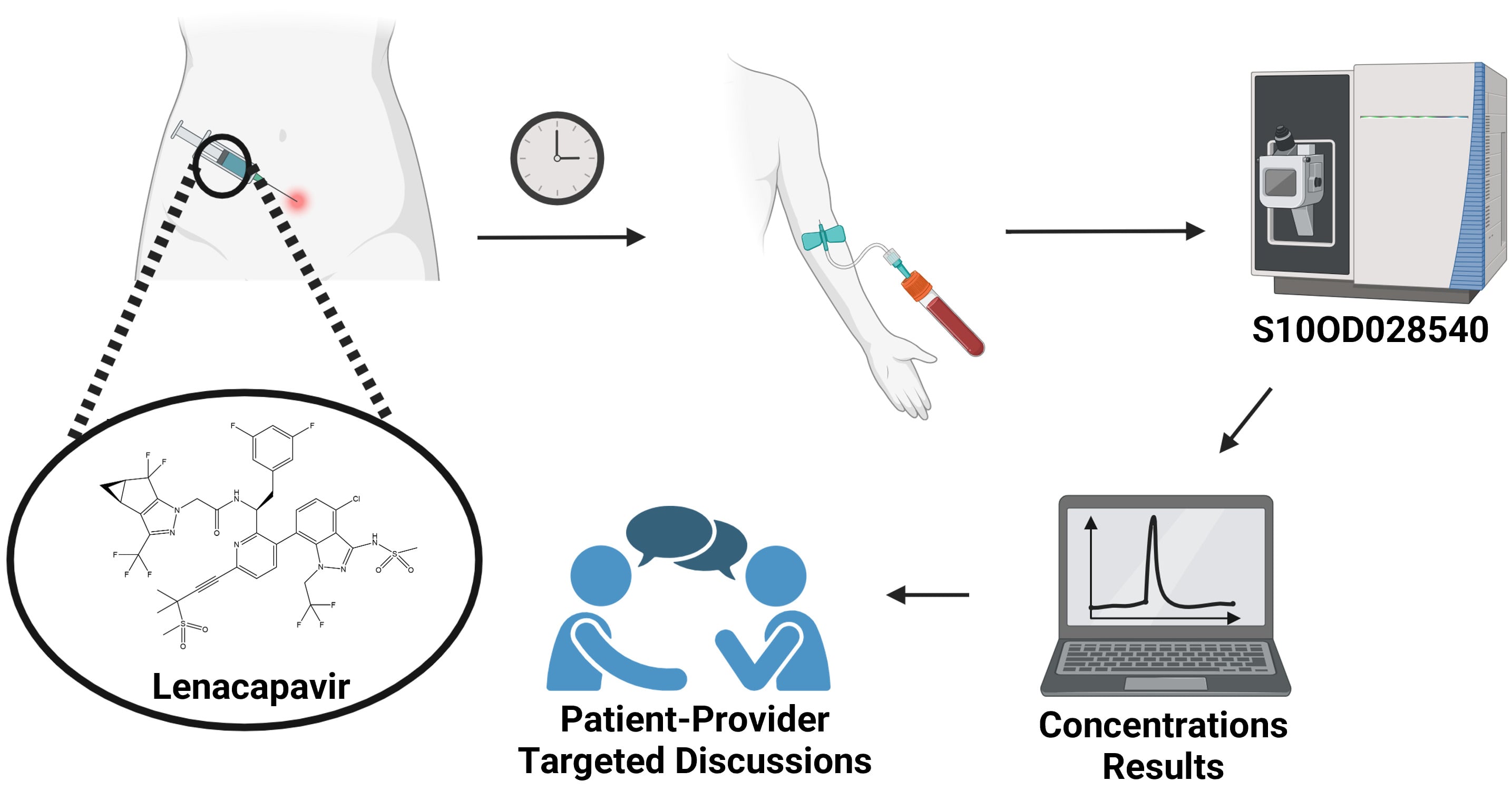
“What has been understood among researchers in this space is the importance of having adequate concentrations of antiretrovirals in order to prevent HIV infection,” said Dr. Aaron Devanathan, an Assistant Professor in the Department of Pharmacy and Therapeutics at the University of Pittsburgh School of Pharmacy. “To understand those concentrations, it’s necessary to measure that amount in biological matrices—in the blood, the tissues, areas that we know are important for HIV infection.” Dr. Devanathan and his team used instruments funded by ORIP’s S10 programs to develop and validate methods for determining concentrations of lenacapavir in human blood and tissue (Figure 2).17 As recently as May 2025, S10-funded instruments were used to measure lenacapavir levels in an individual.18 “It’s very important that we have protective concentrations of lenacapavir throughout the 6‑month interval, and tissues tend to be much more complex than blood, so ultra-sensitive instrumentation is required,” Dr. Devanathan explained.
Studies of lenacapavir’s behavior in humans revealed its extraordinarily long half-life and fitness for subcutaneous long-acting injection, two key points in its groundbreaking nature. Because lenacapavir persists in humans for 6 months and can be administered in a single injection, people can remain protected for an entire year with only two visits to the clinic, making it much easier for people to protect themselves from HIV infection. ORIP’s ongoing support at every step of the research process provides the foundation for state-of-the-art science and transformative developments, such as lenacapavir. “Without the support of ORIP, our role as a center for national primate research would not be possible,” Dr. Burgos said. “That support is key, and all the achievements that we have in being able to provide these animals for sound science is a true testament to what ORIP support has meant.”
References
1 Bekker LG, Das M, Abdool Karim Q, et al. Twice-yearly lenacapavir or daily F/TAF for HIV prevention in cisgender women. N Engl J Med. 2024 Oct 3;391(13):1179–1192. doi:10.1056/NEJMoa2407001.
2 Kelley CF, Acevedo-Quiñones M, Agwu AL, et al. Twice-yearly lenacapavir for HIV prevention in men and gender-diverse persons. N Engl J Med. 2025 Apr 3;392(13):1261–1276. doi:10.1056/NEJMoa2411858.
3 von Schwedler UK, Stemmler TL, Klishko VY, et al. Proteolytic refolding of the HIV-1 capsid protein amino-terminus facilitates viral core assembly. EMBO J. 1998 Mar 16;17(6):1555–1568. doi:10.1093/emboj/17.6.1555.
4 Shin R, Tzou YM, Krishna NR. Structure of a monomeric mutant of the HIV-1 capsid protein. Biochemistry. 2011 Nov 8;50(44):9457–9467. doi:10.1021/bi2011493.
5 Shin R, Tzou YM, Wong HC, Krishna NR. 1H, 15N, and 13C resonance assignments for a monomeric mutant of the HIV-1 capsid protein. Biomol NMR Assign. 2012 Oct;6(2):131–134. doi:10.1007/s12104-011-9340-3.
6 Ning J, Erdemci-Tandogan G, Yufenyuy EL, et al. In vitro protease cleavage and computer simulations reveal the HIV-1 capsid maturation pathway. Nat Commun. 2016 Dec 13;7:13689. doi:10.1038/ncomms13689.
7 Zhang H, Hou G, Lu M, et al. HIV-1 capsid function is regulated by dynamics: quantitative atomic-resolution insights by integrating magic-angle-spinning NMR, QM/MM, and MD. J Am Chem Soc. 2016 Oct 26;138(42):14066–14075. doi:10.1021/jacs.6b08744.
8 Summers BJ, Digianantonio KM, Smaga SS, et al. Modular HIV-1 capsid assemblies reveal diverse host-capsid recognition mechanisms. Cell Host Microbe. 2019 Aug 14;26(2):203–216.e6. doi:10.1016/j.chom.2019.07.007.
9 Tzou YM, Shin R, Krishna NR. HIV-1 virus interactions with host proteins: interaction of the N-terminal domain of the HIV-1 capsid protein with human calmodulin. Nat Prod Commun. 2019 May;14(5). doi:10.1177/1934578X19849190.
10 Huang PT, Summers BJ, Xu C, et al. FEZ1 is recruited to a conserved cofactor site on capsid to promote HIV-1 trafficking. Cell Rep. 2019 Aug 27;28(9):2373–2385.e7. doi:10.1016/j.celrep.2019.07.079.
11 Lu M, Russell RW, Bryer AJ, et al. Atomic-resolution structure of HIV-1 capsid tubes by magic-angle spinning NMR. Nat Struct Mol Biol. 2020 Sep;27(9):863–869. doi:10.1038/s41594-020-0489-2.
12 Christensen DE, Ganser-Pornillos BK, Johnson JS, Pornillos O, Sundquist WI. Reconstitution and visualization of HIV-1 capsid-dependent replication and integration in vitro. Science. 2020 Oct 9;370(6513):eabc8420. doi:10.1126/science.abc8420.
13 Wei G, Iqbal N, Courouble VV, et al. Prion-like low complexity regions enable avid virus-host interactions during HIV-1 infection. Nat Commun. 2022 Oct 6;13(1):5879. doi:10.1038/s41467-022-33662-6.
14 Sun Q, Levy RM, Kirby KA, Wang Z, Sarafianos SG, Deng N. Molecular dynamics free energy simulations reveal the mechanism for the antiviral resistance of the M66I HIV-1 capsid mutation. Viruses. 2021 May 15;13(5):920. doi:10.3390/v13050920.
15 Swanstrom AE, Gorelick RJ, Welker JL, et al. Long-acting lenacapavir protects macaques against intravenous challenge with simian-tropic HIV. EBioMedicine. 2023 Sep;95:104764. doi:10.1016/j.ebiom.2023.104764.
16 Bekerman E, Yant SR, VanderVeen L, et al. Long-acting lenacapavir acts as an effective preexposure prophylaxis in a rectal SHIV challenge macaque model. J Clin Invest. 2023 Aug 15;133(16):e167818. doi:10.1172/JCI167818.
17 West RE 3rd, Oberly PJ, Riddler SA, Nolin TD, Devanathan AS. Development and validation of an ultra-high performance liquid chromatography-tandem mass spectrometry method for quantifying lenacapavir plasma concentrations: Application to therapeutic monitoring. J Chromatogr B Analyt Technol Biomed Life Sci. 2023 Nov 15;1230:123905. doi:10.1016/j.jchromb.2023.123905.
18 Rai MA, Blazkova J, Kardava L, et al. Sustained virologic suppression of multidrug-resistant HIV in an individual treated with anti-CD4 domain 1 antibody and lenacapavir. Nat Med. 2025 Feb;31(2):427–432. doi:10.1038/s41591-024-03357-0.